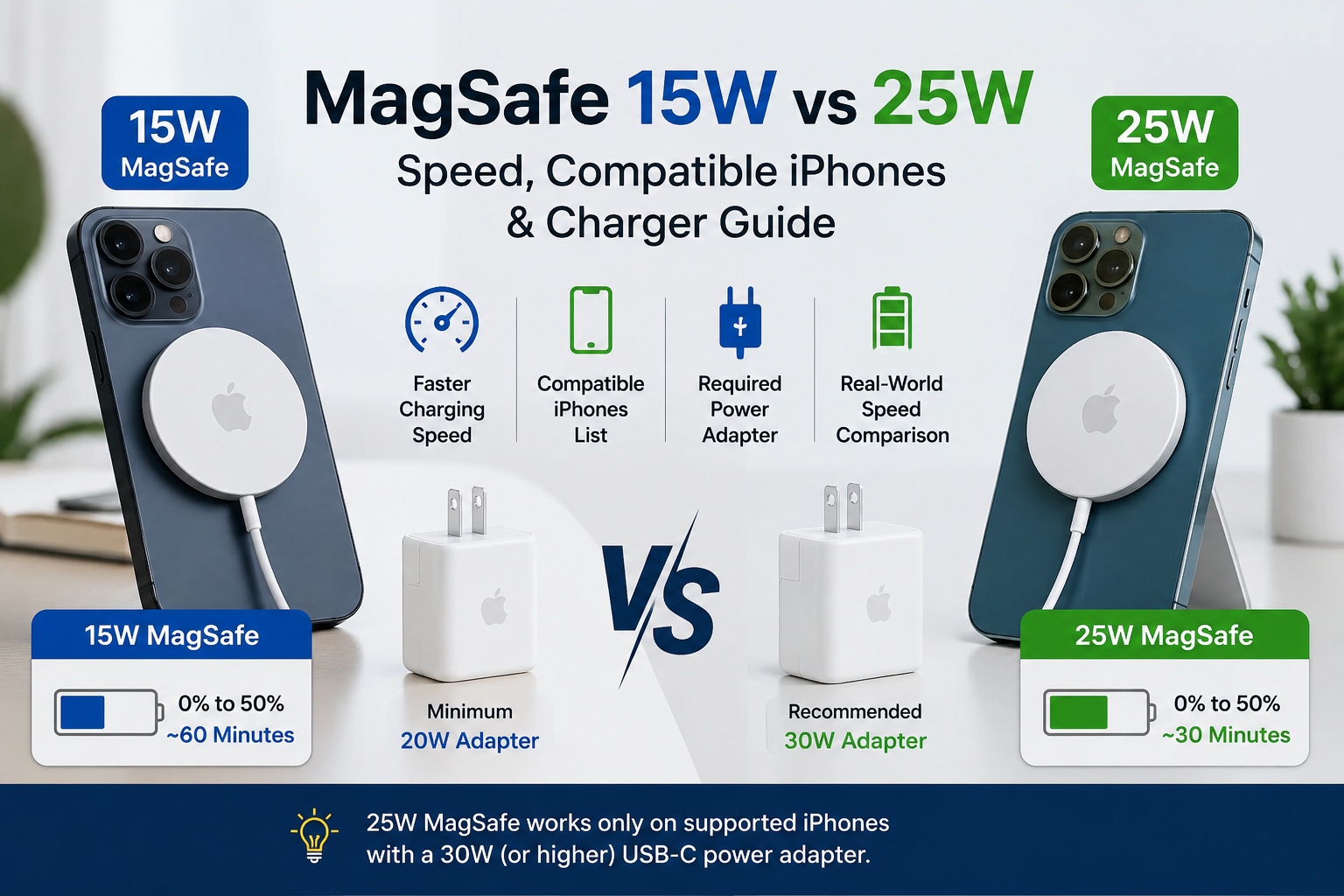
Apple MagSafe 15W vs 25W Charger in Pakistan: Speed Difference, iPhone Support & Adapter
Wireless charging is incredibly convenient, but Apple’s recent updates have left many Pakistani buyers confused. While the older MagSafe model reached a maximum of 15W, the newer version can reach up to 25W.
However, not every iPhone can handle this faster speed, and using the wrong wall plug will bottleneck your charging. This guide breaks down exactly how these two models compare, which iPhones can actually use the 25W speed, and what you need to buy to make it work.
What Is the Main Difference Between 15W and 25W MagSafe?
The major differences lie in the maximum power output, the charging standard used, and the physical build quality of the cable.
1st Generation MagSafe (15W Max): This older version launched alongside the iPhone 12 series. It features a standard smooth white rubber cable that is prone to cracking over time. Its speed stops at 15W for compatible iPhones.
2nd Generation MagSafe (25W Max): This is the newer model featuring a highly durable, premium braided nylon cable that handles daily wear and tear much better. It supports the upgraded Qi2 standard and can deliver up to 25W of wireless power.
Technical Comparison Table
| Feature | 1st Gen MagSafe Charger | 2nd Gen MagSafe Charger |
| Maximum Wireless Power | Up to 15W | Up to 25W |
| Cable Type | Smooth white rubber | Premium braided nylon |
| Charging Standard | Original MagSafe / Qi | Qi2 Certified / Original MagSafe |
| Required Wall Plug | 20W USB-C Adapter | 30W or higher USB-C Adapter |
| Real Speed (0% to 50%) | Takes around 50 to 60 minutes | Takes about 30 minutes (supported models) |
Real-World Charging: How Much Faster Is 25W MagSafe?
On paper, the jump from 15W to 25W MagSafe sounds huge — but in real use, the actual difference depends on which iPhone you have, which adapter you’re using, your battery percentage, and how warm the phone gets during charging.
The newer 25W MagSafe charger can push more power at the beginning of a charge session on supported iPhones, which means it can top up the battery noticeably faster than the older 15W version. This matters most when your battery is low and you want a quick boost before heading out.
That said, wireless charging is never perfectly linear. As the iPhone heats up or the battery level climbs, charging speed naturally slows down to protect battery health. So while 25W MagSafe can be clearly faster than 15W in the early part of charging, the gap becomes less dramatic later in the cycle. In practical terms, the 25W version is better for quicker top-ups, while the 15W version is still fine for desk use, overnight charging, and general convenience.
Which iPhones Support MagSafe?
This is where many buyers in Pakistan get confused. There are two separate questions here:
- Which iPhones support MagSafe at all?
- Which iPhones can actually benefit from the newer 25W charging setup?
These are not the same thing.
iPhones with MagSafe magnetic support
The magnetic MagSafe experience applies to:
- iPhone 12 series
- iPhone 13 series
- iPhone 14 series
- iPhone 15 series
- newer compatible iPhone 16 / 17 models
These phones have the magnetic alignment system built into the back, so the charger snaps into place properly.
Older iPhones
Older iPhones like iPhone 11, iPhone XS, iPhone XR, iPhone X, and iPhone 8 series can still charge on a MagSafe charger as a regular Qi wireless charger, but they do not get the proper magnetic snap-on MagSafe experience.
Which iPhones Actually Support 25W MagSafe Charging?
This is the most important section of the blog.
Just because an iPhone supports MagSafe does not automatically mean it gets the full 25W charging speed. Apple’s newer MagSafe charging system is designed to deliver higher wireless charging only on supported newer iPhone models with the correct adapter setup.
An iPhone will only pull the amount of power its internal hardware is built to handle.
iPhone 16 and 17 Series (including Plus, Pro, Pro Max, and Air): These newer models have updated internal coils that fully support the fast 25W speed.
iPhone 12, 13, 14, and 15 Series: These phones are built to accept a maximum of 15W. They will work safely on the new 25W charger, but they will only charge at 15W.
iPhone 12 mini and 13 mini: Due to their small size and smaller battery surface, these two models have a limit of 12W max.
iPhone 8 to iPhone 11 & Android Devices: These do not have magnets. They sit flat on the pad and charge at a slow 7.5W using basic wireless charging.
iPhone Compatibility Table: Apple MagSafe 15W Vs 25W Charger
| iPhone Series | Magnetic MagSafe Support | Typical MagSafe Charging Category |
| iPhone 12 series | Yes | Up to 15W MagSafe charging |
| iPhone 13 series | Yes | Up to 15W MagSafe charging |
| iPhone 14 series | Yes | Up to 15W MagSafe charging |
| iPhone 15 series | Yes | Up to 15W MagSafe charging |
| Newer compatible iPhone 16 / 17 models | Yes | Can benefit from newer higher MagSafe charging setup |
| iPhone 11 / X / XS / XR / 8 series | No magnetic MagSafe support | Wireless charging only, no magnetic MagSafe snap |
Which Apple Adapter Do You Need for MagSafe Charging?
You cannot get fast wireless speeds if your wall adapter doesn’t push enough power into the MagSafe cable.
To get 15W wireless speed: You need at least a 20W USB-C wall plug.
To get the full 25W wireless speed: You must use a 30W or higher USB-C wall plug.
| Wall Plug Used | Wireless Output on 1st Gen MagSafe | Wireless Output on 2nd Gen MagSafe |
| 20W USB-C Plug | 15W Max | 15W Max (Power Restrained) |
| 30W USB-C Plug | 15W Max | 25W Full Speed |
| 45W / 65W+ Plug | 15W Max | 25W Full Speed |
If you connect the newer 25W MagSafe cable into an old 20W iPhone charger, it will automatically drop its speed down to 15W.
Where to Buy the 100% Original 25W Charger in Pakistan
Because local mobile markets are filled with cheap copies that heat up and ruin your battery health, you should only buy from trusted sources.
You can order the 100% Original Imported Apple MagSafe Charger 25W (2nd Gen) for Rs. 14,999 here. This is genuine international retail stock that guarantees fast charging speeds and full thermal protection for your iPhone.
Related Guides
Frequently Asked Questions
Q1: Which is better, 15W or 25W charging?
The 25W option is much better for newer iPhones because it cuts your charging time in half, while 15W is perfectly fine for older models.
Q2: Is 15W MagSafe considered fast charging?
Yes, for wireless standards, 15W is considered fast, though standard wired USB-C cables are still faster.
Q3: Does MagSafe degrade your phone battery faster?
Only if you use cheap fake copies; original Apple chargers manage heat safely so your battery health does not suffer.
Q4: Is Qi2 or MagSafe better for iPhone?
They are almost identical since Qi2 is built using Apple’s technology, but official MagSafe has better software integration with iOS.
Q5: Can I safely charge a 15W iPhone with a 25W charger?
Yes, your phone will automatically communicate with the charger and safely limit the power intake to exactly 15W.
Q6: Can a 15W or 25W charger damage my phone battery?
Original Apple chargers will never damage your battery because they have built-in chips to prevent overheating.
Q7: Should I buy a 25W or a 45W wall plug for MagSafe?
A 30W adapter is ideal; buying a 45W plug is safe but it will not make the MagSafe charge any faster than 25W.
Q8: Is 25W wireless charging enough for daily use?
Yes, it matches the speed of traditional wired fast chargers, making it excellent for your office desk or nightstand.
Q9: Why do people say MagSafe was discontinued?
They are confusing it with the old MacBook magnetic laptop chargers; the iPhone MagSafe system is completely active and supported.
Q10: Is it okay to use MagSafe every single day?
Yes, it is perfectly safe, just avoid heavy gaming or video editing while the phone is actively charging on the magnet.
Q11: What is the healthiest way to charge an iPhone?
Turn on “Optimized Battery Charging” in your settings, keep your battery between 20% and 80%, and avoid extreme heat.
Q12: Is a 15W charger considered slow?
It is slower than modern wires, but it is still highly functional for steady overnight top-ups or car mounts.